Some nebulae glow. Some shimmer. Some blaze with colour so bright they feel alive. And then there are the ones that don’t shine at all, the ones that hide in the dust, carved out of darkness, shaped by absence rather than light. The Dark Wolf Nebula, SL‑17, is one of those rare creatures. A silhouette. A shadow. A cosmic animal outlined not by stars, but by the places where starlight fails to reach. It’s no surprise that astronomers and storytellers alike have taken to calling it Fenrir.
The Dark Wolf Nebula, also known as SL‑17 or the Fenrir Nebula, is one of those rare deep‑sky objects that feels more like a creature than a cloud. A silhouette carved from dust, stretched across the glowing backdrop of Scorpius, it looks uncannily like a wolf prowling through the Milky Way. And once you see it, you understand why astronomers and imagers alike have embraced its mythic nickname: Fenrir.
This nebula doesn’t shine. It devours light. And that makes it one of the most compelling dark structures in the southern sky.
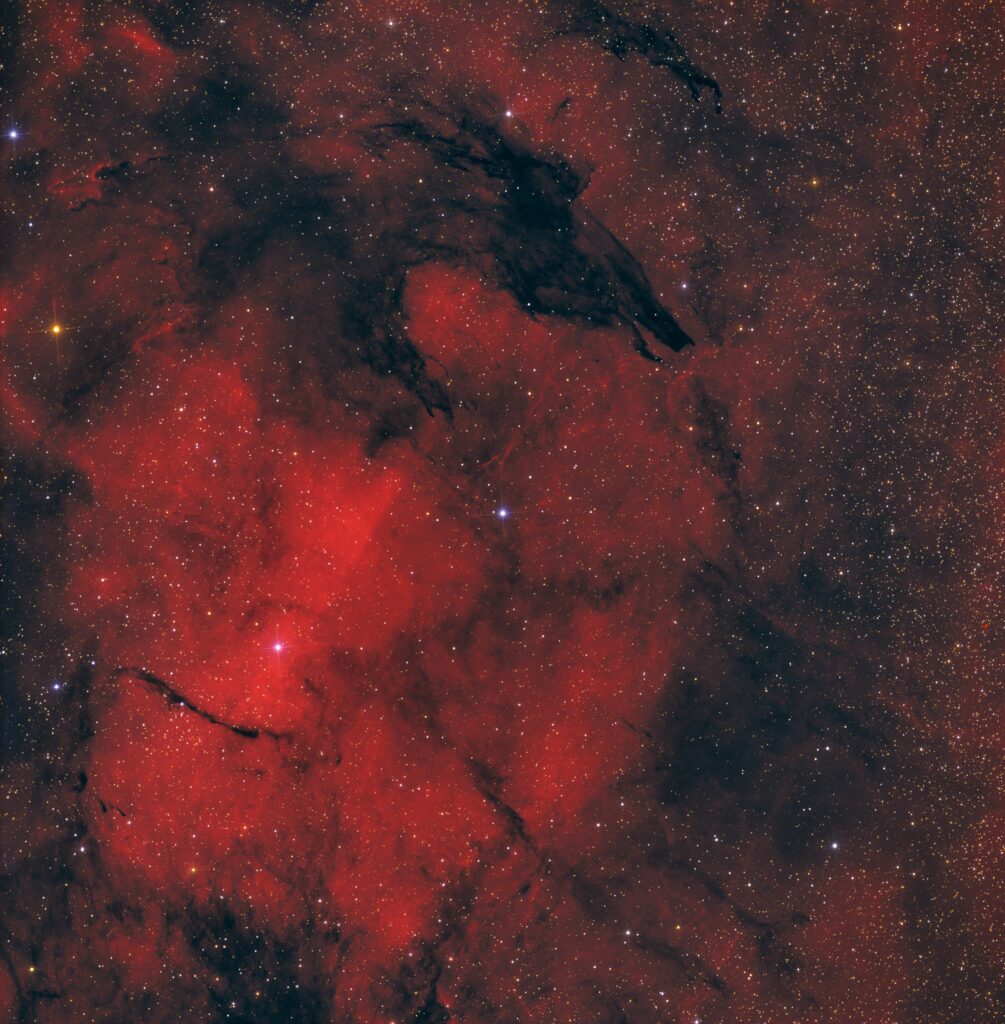
What Exactly Is the Dark Wolf Nebula?
What Exactly Is the Dark Wolf Nebula?
SL‑17 is a dark nebula, a dense cloud of interstellar dust that blocks the light of the stars and emission nebulae behind it. Instead of glowing, it appears as a shadow—an absence—outlined by the bright hydrogen clouds of the surrounding Gum 55 (RCW 113) H II region.
It lies approximately 5,300 light‑years away in the constellation Scorpius .
The nebula was first catalogued in 1976 by Swedish astronomers A. Sandqvist and K.P. Lindroos during their study of interstellar formaldehyde in southern dark clouds .
Its wolf‑like shape is not imagination—it’s a well‑documented morphological feature. The “snout,” “back,” and “haunches” are all formed by dense dust lanes silhouetted against the glowing gas behind them, giving the nebula its unmistakable animal form.
The Science Behind the Shadow
Dark nebulae like SL‑17 are not empty. They are stellar nurseries in waiting—cold, dense regions where gravity can eventually collapse gas and dust into new stars.
Recent observational studies highlight the critical role dust plays in regulating star formation within regions like Gum 55. Dust grains:
- absorb ultraviolet and visible light from nearby young stars
- re‑emit that energy as infrared radiation
- keep surrounding gas cool enough for gravitational collapse
- provide surfaces for molecular hydrogen (H₂) formation, the essential fuel for star birth.
These processes were confirmed through multi‑wavelength analysis of SL‑17, showing how the nebula acts as a thermal moderator and chemical catalyst within its environment .
In other words: The Dark Wolf Nebula may look like a void, but it is quietly shaping the future stars of the region.
Location and Observational Details
- Constellation: Scorpius
- Distance: ~5,300 light‑years (estimates vary slightly across sources)
- Type: Dark nebula (absorption) embedded in the RCW 113 / Gum 55 complex
- Coordinates (J2000): RA 16h 54m 10s, Dec −43° 23′ 10″
- Apparent size: ~60 × 60 arcminutes—roughly four full Moons across the sky
Because SL‑17 is dark, it is best captured using long‑exposure broadband imaging to reveal the dust silhouette, often paired with Hα to highlight the glowing gas around it.
Why It’s Called the Fenrir Nebula
The nickname “Fenrir Nebula” comes from its striking resemblance to the legendary wolf Fenrir of Norse mythology. Fenrir is the monstrous wolf destined to break free at Ragnarök, swallowing the sun and bringing the world to its end.
In the myths, Fenrir is not evil—he is inevitable. A force too wild to bind, too powerful to contain.
And that symbolism fits SL‑17 perfectly.
The nebula’s shape looks like a wolf carved from shadow, jaws open toward the glowing regions of Scorpius. It feels ancient, restless, and mythic—like a creature waiting in the dark between the stars. The comparison has become so common that “Fenrir Nebula” is now listed as an official alternative designation in astronomical references .
Gum 55: The Fiery Backdrop Behind the Wolf
SL‑17 lies embedded within the much larger Gum 55 (RCW 113) complex—an expansive H II region glowing with ionised hydrogen. Gum 55 is a massive stellar nursery, filled with young, hot stars whose radiation sculpts the surrounding gas into shells, ridges, and pillars.
Key scientific features of Gum 55:
- It is a bright emission nebula energized by newly formed massive stars.
- Its radiation pressure pushes away surrounding material, creating the dramatic structures seen in wide‑field images.
- The Dark Wolf Nebula is visible only because Gum 55 glows so intensely behind it.
In other words: Gum 55 is the light; SL‑17 is the shadow. Without the bright hydrogen glow of Gum 55, the wolf shape would be invisible.
The Mythic and the Scientific
What makes the Dark Wolf Nebula so compelling is the way it blends science and story.
Scientifically, it is a dense molecular cloud shaping the thermal and chemical environment of a star‑forming region. Mythologically, it is a cosmic wolf stalking the Milky Way, echoing a story thousands of years old.
Both interpretations are true in their own way.
The universe is full of glowing nebulae that demand attention. But SL‑17 is different. It whispers. It hides. It reveals itself slowly, like a creature emerging from the dark. And in that quiet, shadowed shape, we find both the physics of star formation and the poetry of myth.
Fenrir lives in the sky—not as a destroyer, but as a reminder that darkness is not empty. It has structure. It has purpose. It has presence.
And sometimes, it even has teeth.