If there’s one region of the sky that feels like the universe showing off, it’s the Eagle Nebula. This is the home of the famous Pillars of Creation — the towering structures that have been plastered across textbooks, documentaries, and every astronomy page on the internet. And honestly, it deserves the hype.
The Eagle Nebula sits around 5,700–7,000 light‑years away in the constellation Serpens. It’s a massive star‑forming region, essentially a cosmic maternity ward where new stars are born, shaped, and sometimes blasted apart by their own energetic neighbours. It’s dramatic, chaotic, beautiful, and scientifically fascinating all at once.
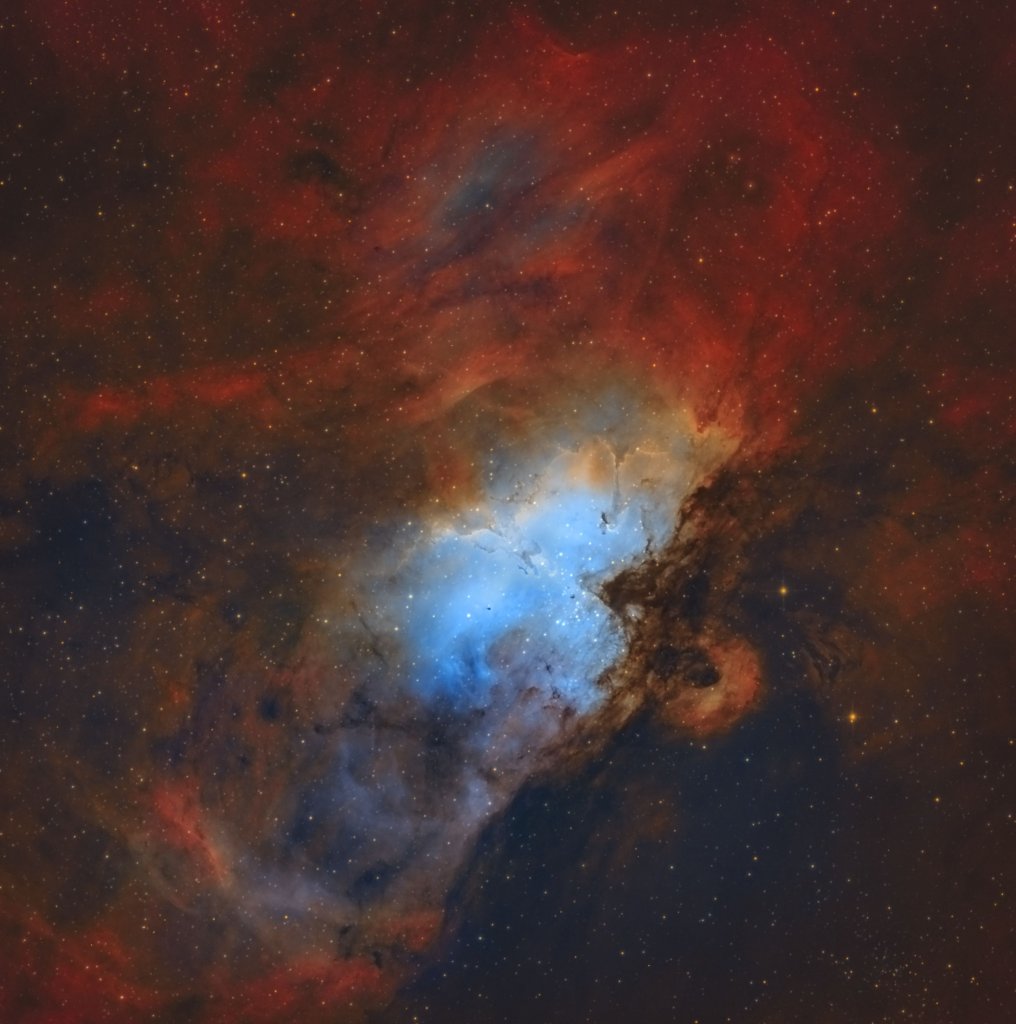
What the Eagle Nebula Actually Is
Astronomers classify the Eagle Nebula (also known as M16, NGC 6611, or IC 4703) as an H II region. That means it’s full of glowing hydrogen gas energized by young, hot stars. Embedded within it is a young open star cluster containing roughly 8,000 stars, many of them only one to two million years old. In cosmic terms, that’s basically newborn.
This whole structure sits inside the Sagittarius–Carina spiral arm of the Milky Way — the same arm we photograph when we shoot the bright core of the galaxy.
The Pillars of Creation
The Pillars of Creation are the celebrities of the nebula. These dusty, towering columns stretch about five light‑years in height and are made of dense gas and dust. Inside them are tiny, ultra‑dense pockets called EGGs (Evaporating Gaseous Globules). Some of these contain protostars — baby stars still wrapped in their dusty cocoons.
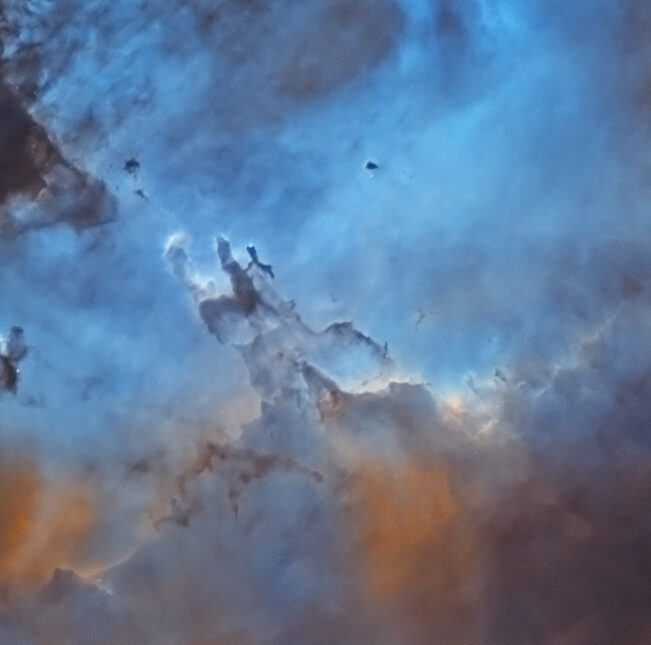
The wild part is that these pillars are being eroded by intense ultraviolet radiation from nearby massive stars. They’re literally being carved away while still trying to form new stars. It’s cosmic multitasking at its finest.
A Region Sculpted by Stellar Chaos
The Eagle Nebula is a perfect example of how the universe recycles itself. Old stars explode and their gas becomes nebulae. Gravity pulls that gas together to form new stars. Those new stars blast radiation and stellar winds that sculpt the surrounding clouds. Eventually, they explode and the cycle begins again.
Infrared and X‑ray observations reveal thousands of young stars hidden inside the dust — stars we can’t see in visible light. This region is buzzing with activity, from collapsing gas clouds to energetic outflows and shock fronts.
Key Scientific Discoveries
1995: Hubble’s first Pillars of Creation image This was the moment the Eagle Nebula became a global icon. The image revealed the structure of the pillars and the star‑forming EGGs inside them, changing how the public saw deep‑sky astronomy.
Multi‑wavelength studies Infrared and X‑ray observations have shown that:
• Stars are forming inside the pillars.
• Hot young stars outside the pillars are blasting them with radiation.
• Gas is being stripped away in long streamers.
• The pillars are slowly dissolving over time.
The powerhouse star The brightest star in the region, HD 168076, is an O‑type star roughly 80 times the mass of the Sun and up to a million times brighter. Its radiation is one of the main forces sculpting the nebula.
Why the Eagle Nebula Feels So Magical
Beyond the science, the Eagle Nebula is emotionally powerful. The colours, the structure, the drama — it’s the kind of nebula that makes you stop scrolling and remember how tiny we are in a galaxy full of star‑making factories.
And here’s the mind‑bending part: we’re seeing it as it looked about 6,500 years ago. The light is only just reaching us now. The pillars may already look completely different, but we won’t know for thousands of years. It’s like receiving a cosmic postcard with a massive delay.
Sources
NASA / ESA Hubble Space Telescope NASA Chandra X‑ray Observatory European Southern Observatory (ESO) Hester, J. J. et al. (1996). “Hubble Space Telescope WFPC2 Imaging of M16.” McLeod, A. F. et al. (2015). “Stellar Feedback in the Eagle Nebula.”