Some objects in the night sky have names that perfectly capture what they look like. Others require a healthy dose of imagination. The Fighting Dragons of Ara, officially known as NGC 6188, somehow manages to be both.
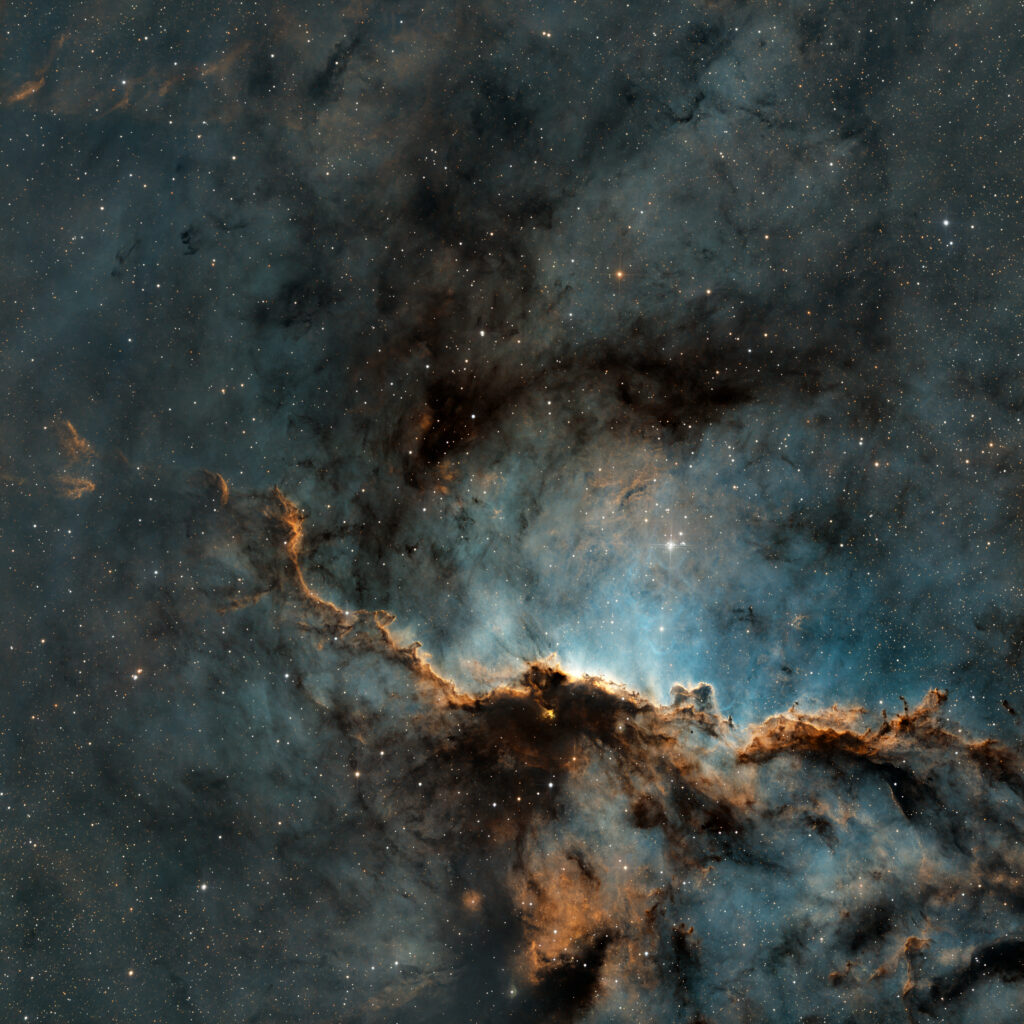
Located deep in the southern constellation of Ara, this spectacular emission nebula stretches across space like two mythical beasts locked in an eternal battle. With its sweeping clouds of glowing hydrogen, dark dust lanes, and brilliant newborn stars, it’s one of the Southern Hemisphere’s most dramatic deep-sky treasures — and one that many Northern Hemisphere observers will never get to see.
If you’ve ever wondered what happens when massive stars sculpt an entire region of our galaxy, the Fighting Dragons of Ara offers a front-row seat.
Meet the Dragons
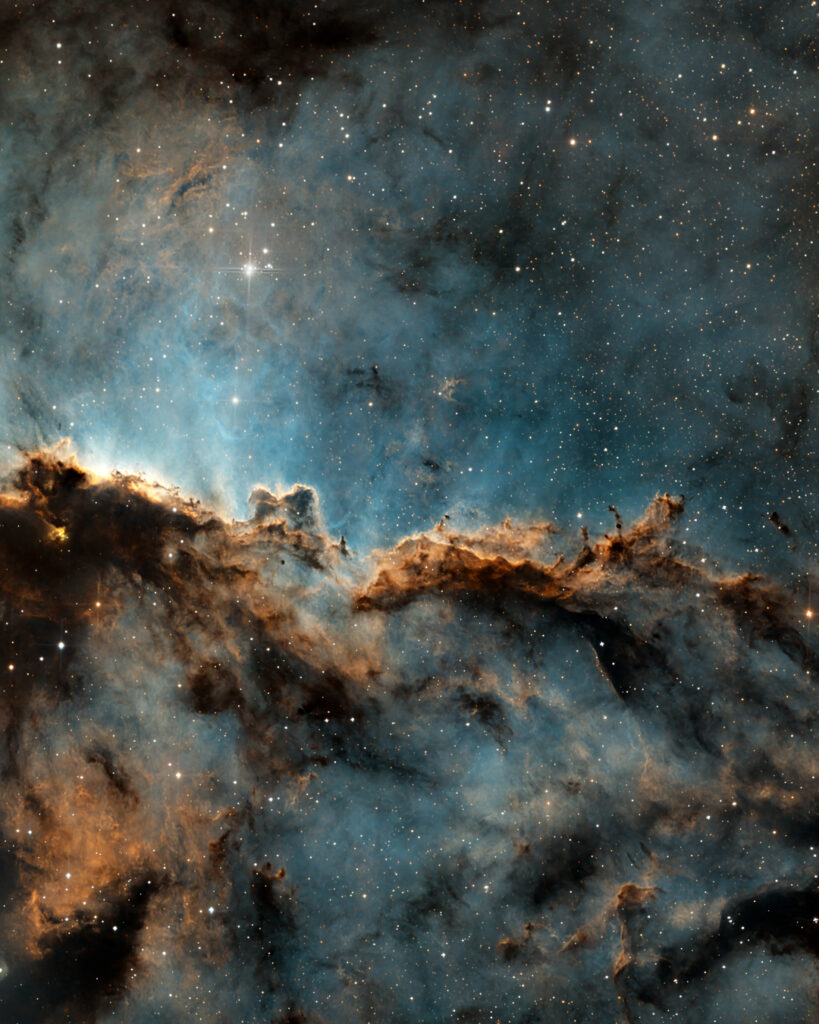
The Fighting Dragons of Ara lies approximately 4,000 light-years away in the direction of the constellation Ara. The nebula spans around 200 light-years across, making it an enormous region of gas and dust undergoing active star formation.
Its nickname comes from the striking shape of the glowing hydrogen clouds, which resemble two dragons facing each other in combat. Once you’ve seen them, it’s difficult to unsee them — although after several hours of processing astrophotography data, you may also start seeing dragons in your hard drive, your coffee cup, and possibly your backyard observatory.
A Stellar Nursery on a Grand Scale
NGC 6188 is classified as an emission nebula, meaning the gas itself glows after being energised by nearby stars.
At the heart of this region lies the young stellar association known as Ara OB1, a group of extremely hot and massive O-type and B-type stars. These stars are cosmic powerhouses:
- They can be tens of times more massive than our Sun.
- Their surface temperatures exceed 30,000°C.
- They emit enormous amounts of ultraviolet radiation.
This intense radiation strips electrons from nearby hydrogen atoms in a process called ionisation. When those electrons recombine with the hydrogen atoms, they emit light at specific wavelengths — most notably the deep red glow of hydrogen-alpha (Hα) that astrophotographers know and love.
The blue-green regions visible in narrowband images come from doubly ionised oxygen, known as OIII, while sulphur emissions contribute deeper red tones when captured with specialised filters.
The Dragons Were Created by Stars
The dramatic pillars, ridges, and sweeping structures visible throughout NGC 6188 weren’t always there.
Over millions of years, the powerful stellar winds from the massive stars of Ara OB1 have been carving into the surrounding molecular cloud. These stellar winds travel at hundreds or even thousands of kilometres per second, compressing some regions while eroding others.
The result is a cosmic sculpture spanning hundreds of light-years:
- Dense pockets of gas collapse to form new stars.
- Intense radiation strips away surrounding material.
- Pillars and ridges emerge where denser gas resists erosion.
It’s the same basic process responsible for famous structures like the Pillars of Creation in the Eagle Nebula — just on a much larger scale.
Hidden Inside the Dragons
The Fighting Dragons of Ara isn’t just beautiful — it’s alive with activity.
Astronomers have identified numerous:
- Young stellar objects (YSOs)
- Protostars
- Embedded star clusters
- Dense molecular clouds
These regions represent stars in various stages of formation, from collapsing gas clouds to fully formed young stars beginning to clear away their natal material.
Some of the youngest stars remain hidden entirely in visible light, buried deep inside thick clouds of dust. Infrared observations reveal these stellar nurseries glowing beneath the dragons’ fiery appearance.
Light from Another Millennium
One of the most fascinating things about observing NGC 6188 is realising just how old the light you’re seeing actually is.
At a distance of around 4,000 light-years, the photons captured by your camera tonight began their journey towards Earth around the year 26 CE.
While the Roman Empire was expanding and long before the invention of the telescope, those photons were already travelling through interstellar space, patiently waiting to collide with a camera sensor in somebody’s backyard observatory in Queensland.
That’s one of the things that makes astrophotography so extraordinary: you’re not just photographing an object. You’re collecting ancient light that has travelled across our galaxy for four millennia.
Photographing the Fighting Dragons
For astrophotographers, the Fighting Dragons of Ara is both a rewarding and challenging target.
Because the nebula emits strongly in hydrogen-alpha, oxygen-III and sulphur-II wavelengths, it responds beautifully to narrowband imaging. Long integration times reveal intricate shock fronts, dark dust structures and subtle colour variations that are invisible to the eye.
The object is particularly well suited to:
- Narrowband imaging (SHO/Hubble Palette)
- Dual-band filters for one-shot colour cameras
- Monochrome cameras with dedicated filters
- Longer focal length telescopes between 500–1000 mm
For Southern Hemisphere observers, it culminates high overhead during the Australian winter months, offering some of the best imaging conditions of the year.
Dragons, Dinosaurs and Deep Space
Interestingly, humans have been associating mysterious giant things with dragons for thousands of years.
Before the word dinosaur was coined in 1842, enormous fossil bones were often identified as dragon remains. Ancient Chinese cultures referred to fossilised bones as long gu — “dragon bones” — and medieval Europeans frequently labelled massive fossils as draco.
So perhaps it’s fitting that modern astronomy continues the tradition.
Except these dragons are real.
Well… real in the sense that they’re giant clouds of ionised hydrogen gas sculpted by stars and spanning hundreds of light-years across the Milky Way.
Which, honestly, is probably cooler than regular dragons anyway.
Final thoughts:
The Fighting Dragons of Ara is one of the Southern Hemisphere’s greatest astrophotography targets. It combines everything that makes deep-sky imaging so captivating: dramatic structure, active star formation, ancient light, and a name that sounds like it belongs in a fantasy novel rather than an astronomy catalogue.
And perhaps that’s fitting.
Because sometimes, when you point a telescope at the universe, you don’t just discover science.
You discover dragons.