NGC 2264 is one of those rare deep‑sky regions where everything feels alive, layered, and full of motion. It’s not just one object but an entire star‑forming complex made up of glowing gas, dark dust, and a young cluster of stars that are still settling into their new cosmic home.
If you’ve ever seen images of the Cone Nebula or the Christmas Tree Cluster, you’ve already met NGC 2264 — they’re all part of the same sprawling structure.
Located about 2,300 light‑years away in the constellation Monoceros, this region sits along the Orion Arm of the Milky Way, not far from the famous Orion Nebula. It’s a busy neighbourhood for star formation, and NGC 2264 is one of its most photogenic residents.
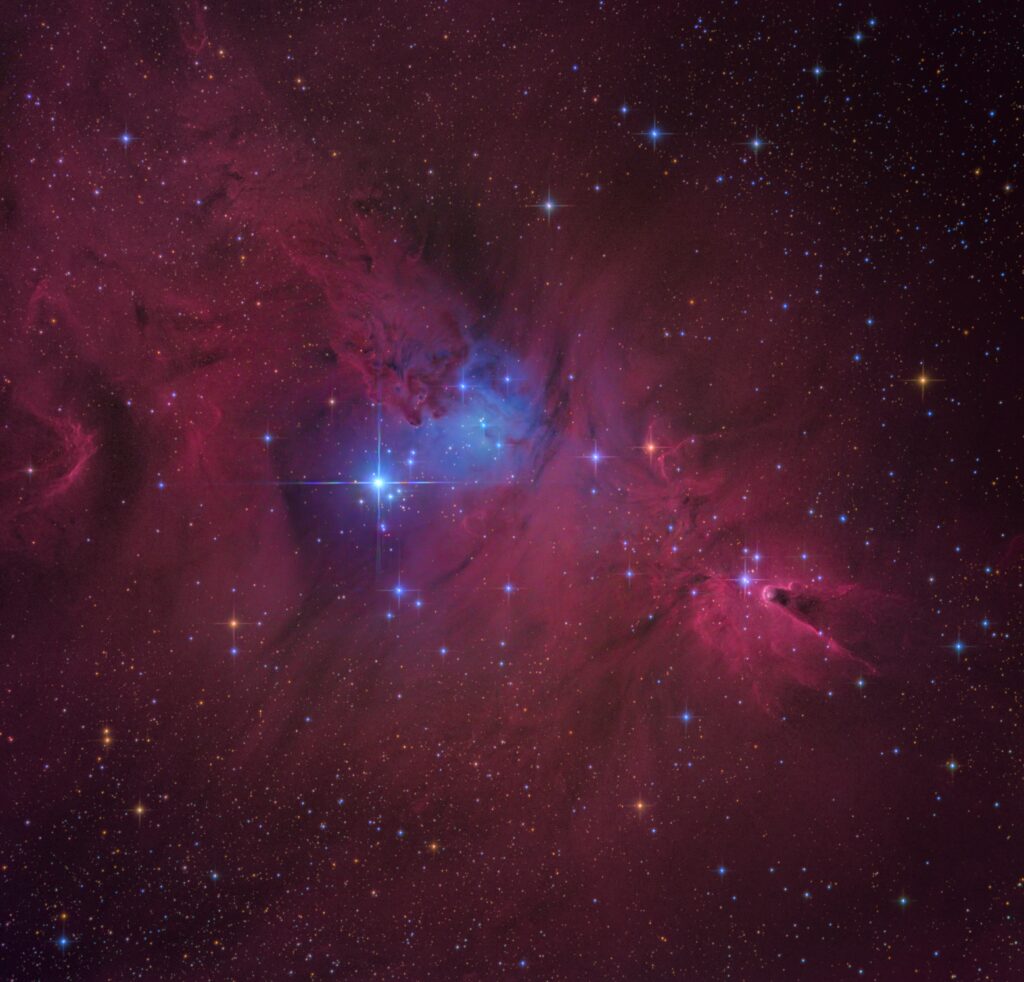
What NGC 2264 Actually Is
NGC 2264 is a combination of two major features: • the Christmas Tree Cluster, a young open star cluster • the Cone Nebula, a towering column of dark dust
Together, they form a massive star‑forming region filled with hydrogen gas, newborn stars, and dense clouds where future stars are still forming.
The Christmas Tree Cluster contains hundreds of young stars, many only a few million years old. These stars are bright, hot, and energetic, and their radiation illuminates the surrounding gas, giving the region its distinctive glow.
The Cone Nebula, on the other hand, is a dramatic, elongated pillar of cold molecular gas and dust. It’s shaped by the intense radiation and stellar winds from nearby massive stars, which carve and sculpt the cloud into its iconic cone shape.
A Region Full of Stellar Birth
NGC 2264 is a textbook example of how stars form in clusters. Inside the dark clouds are dense pockets of gas collapsing under gravity. Some of these pockets contain protostars — young stars still wrapped in their dusty cocoons. Infrared observations reveal dozens of these hidden objects that can’t be seen in visible light.
The region also contains Herbig–Haro objects, which are jets of material launched from newborn stars. These jets slam into surrounding gas, creating shock waves that glow in narrow emission lines. They’re a sign that star formation is actively underway right now.
The Cone Nebula: A Sculpted Shadow
The Cone Nebula is one of the most striking features of NGC 2264. It’s about seven light‑years long and made of dense, cold gas that resists the intense radiation from nearby stars. The bright region at its base is being ionised by a massive young star, S Monocerotis, whose ultraviolet light is slowly eroding the pillar.
This interplay between radiation and dense gas is what shapes many of the dramatic structures we see in star‑forming regions. The Cone Nebula is essentially a shadow — a silhouette carved out by the light of the stars it helped create.
The Christmas Tree Cluster
The Christmas Tree Cluster gets its name from the triangular arrangement of its brightest stars. When imaged, the stars form a shape that resembles a tree, with the Cone Nebula sitting at the tip like a cosmic ornament.
These stars are young, hot, and full of energy. Their stellar winds blow bubbles and cavities into the surrounding gas, influencing the next generation of star formation. It’s a dynamic environment where everything is pushing, pulling, collapsing, and reshaping itself.
What Scientists Have Learned
NGC 2264 has been studied extensively in visible, infrared, and X‑ray wavelengths. These observations have revealed:
• hundreds of young stars at different stages of formation • dense molecular clouds collapsing into new stars • jets and outflows from protostars • shock fronts created by stellar winds • a complex history of triggered star formation
One of the most important findings is that star formation in NGC 2264 happens in waves. Older stars in the cluster appear to have triggered the collapse of nearby gas clouds, leading to new generations of stars forming in sequence.
Why NGC 2264 Feels So Special
NGC 2264 is one of those regions that feels both peaceful and chaotic at the same time. The Cone Nebula stands tall and still, while the Christmas Tree Cluster sparkles with youthful energy. It’s a snapshot of a stellar nursery in full motion — stars being born, clouds being sculpted, and the next generation of the galaxy taking shape.
It’s also incredibly rewarding to photograph. The mix of dark dust, glowing hydrogen, and bright young stars gives astrophotographers endless ways to interpret the scene. Whether you shoot it in broadband, narrowband, or infrared, NGC 2264 always has something new to reveal.
Sources
NASA / ESA Hubble Space Telescope Spitzer Space Telescope ESO Very Large Telescope Reipurth, B. (2008). “The NGC 2264 Star‑Forming Region.” Dahm, S. (2008). “Young Stars and Outflows in NGC 2264.”