The Lagoon Nebula is one of those deep‑sky objects that feels alive the moment you look at it. Even through a small telescope, it glows with this soft, hazy light that hints at something much bigger happening inside. And it is.
This nebula is a full‑blown stellar nursery, a chaotic cloud of gas and dust where new stars are forming, shaping their surroundings, and lighting up the region from within.
Located about 4,000 to 6,000 light‑years away in the constellation Sagittarius, the Lagoon Nebula (also known as M8 or NGC 6523) sits right in the heart of the Milky Way’s brightest, most crowded region. When we photograph the galactic core, we’re essentially looking straight toward the Lagoon’s neighbourhood.
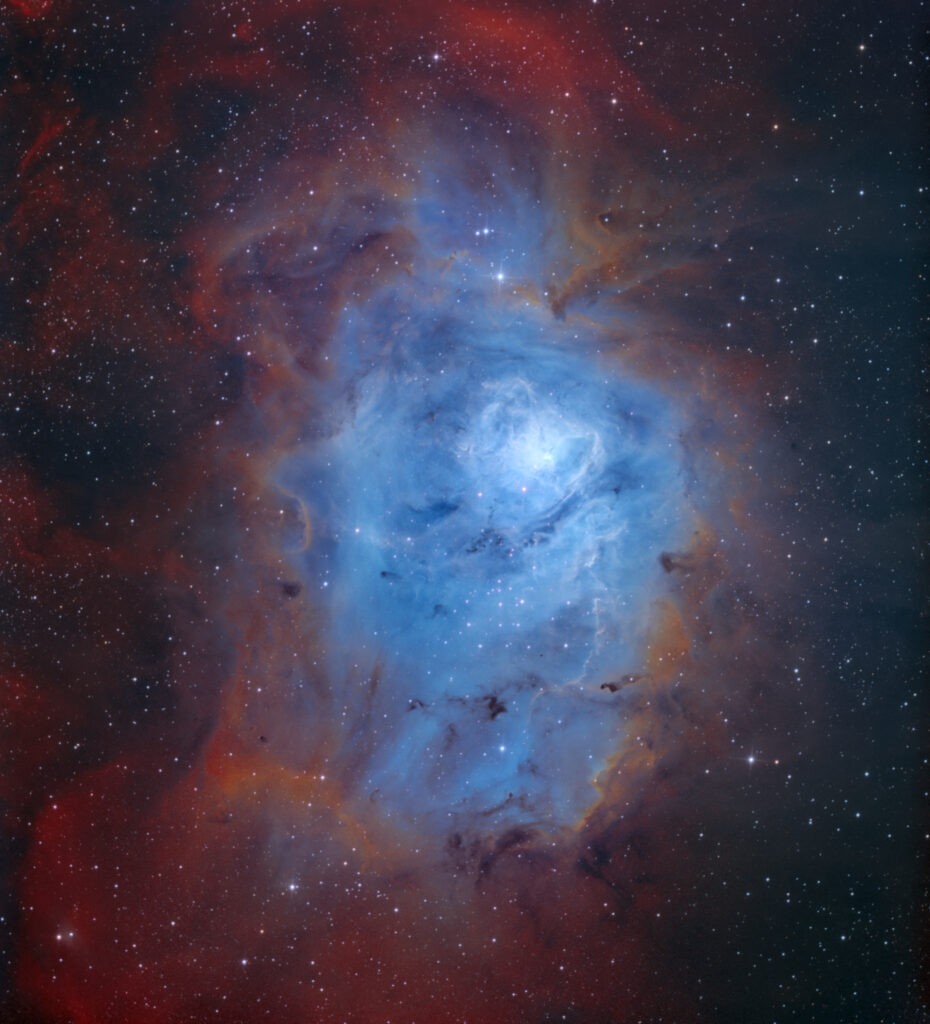
What the Lagoon Nebula Actually Is
The Lagoon Nebula is a massive H II region, meaning it’s full of ionised hydrogen gas glowing from the intense radiation of young, hot stars. It spans more than 100 light‑years across, making it one of the largest star‑forming regions visible from Earth.
At its centre lies a young open cluster called NGC 6530. These stars are only a few million years old, which is incredibly young in cosmic terms. Their ultraviolet radiation is what lights up the nebula and sculpts its structure.
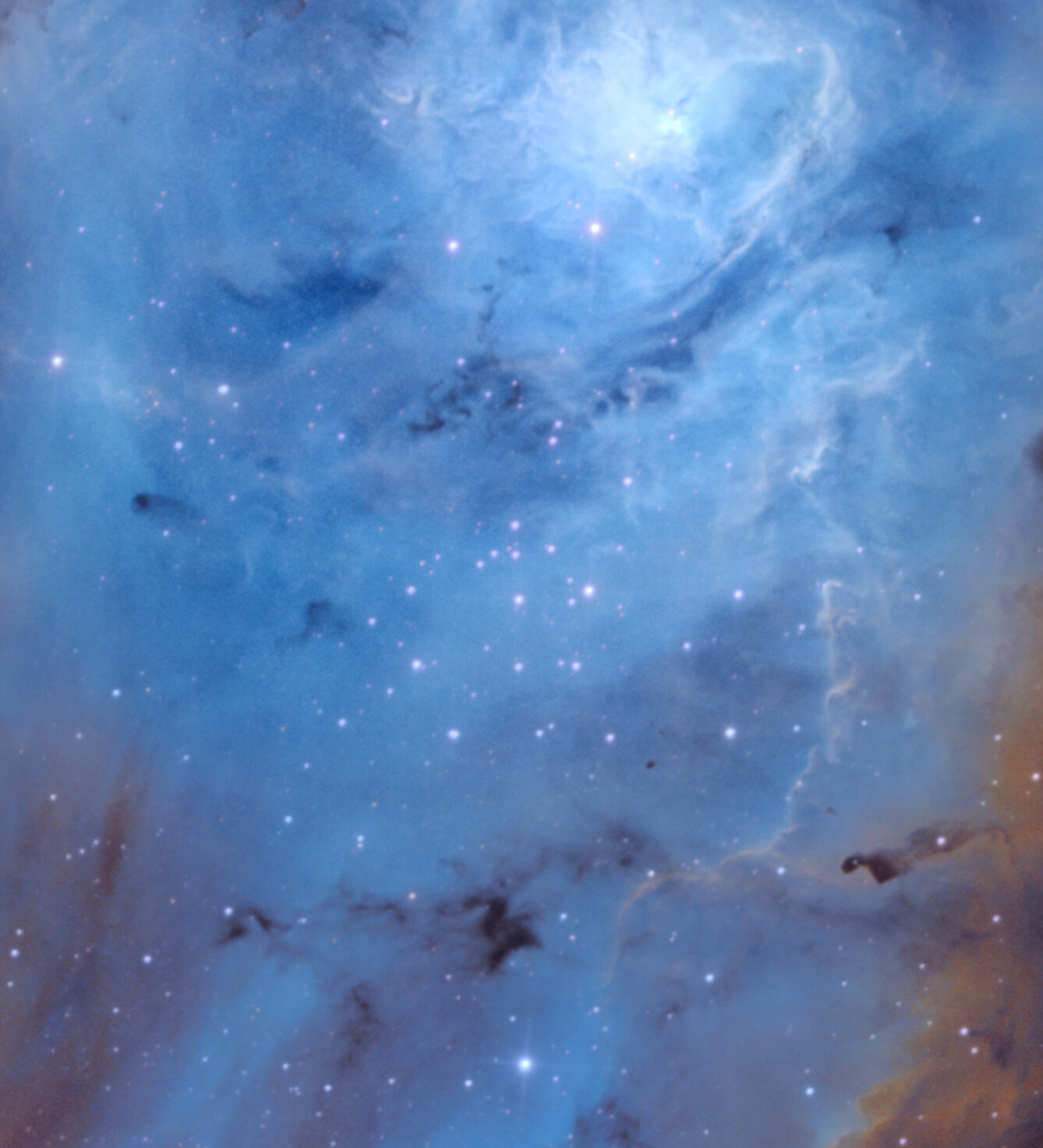
The Lagoon is also home to dense Bok globules — small, dark pockets of gas and dust where stars are quietly forming. These globules look like tiny shadows against the bright nebula, but inside them, gravity is working overtime to collapse material into new suns.
The Hourglass Nebula Inside the Lagoon
One of the most fascinating features of the Lagoon Nebula is the Hourglass Nebula, a bright, compact region shaped by the powerful stellar winds of a young star named Herschel 36. This star is blasting out radiation strong enough to carve cavities in the surrounding gas, creating the hourglass shape we see in high‑resolution images.
The Hourglass is a perfect example of how young stars don’t just form inside nebulae — they actively reshape them. The Lagoon is full of these interactions: shock fronts, ionisation waves, and turbulent flows of gas all pushing and pulling against each other.
What Scientists Have Discovered
The Lagoon Nebula has been studied across multiple wavelengths, each revealing a different layer of activity.
Visible light shows the glowing hydrogen clouds and dark dust lanes. Infrared observations reveal hundreds of young stars hidden inside the dust. X‑ray studies show energetic outflows and high‑temperature plasma around the hottest stars.
These multi‑wavelength views help astronomers understand how stars form, how they influence their environment, and how nebulae evolve over time.
One of the most important discoveries is that the Lagoon Nebula is forming stars in waves. Older stars in the cluster appear to have triggered the formation of younger stars nearby, creating a chain reaction of star birth across the region.
Why the Lagoon Nebula Feels So Special
There’s something uniquely inviting about the Lagoon Nebula. It’s bright, colourful, and full of structure — the kind of nebula that pulls you in even if you’re new to astrophotography. But beneath the beauty is a story of constant change. Stars are forming, winds are blowing, gas is collapsing, and radiation is carving new shapes every moment.
And because the Lagoon is relatively close to us, we get a front‑row seat to all of it. Every image we take is a snapshot of a living, evolving part of our galaxy.
Sources
NASA / ESA Hubble Space Telescope ESO Very Large Telescope Spitzer Space Telescope Tothill, N. F. H. et al. (2008). “The Lagoon Nebula and its Star‑Forming Environment.” Damiani, F. et al. (2004). “X‑ray Studies of NGC 6530 and the Lagoon Nebula.”