November brings meteor showers, close planetary encounters and some excellent pre-dawn observing opportunities. From the Taurids and Leonids to a striking Mars-Jupiter conjunction and Uranus at opposition, there’s something happening throughout the month.
Celestial Events and Conjunctions
3 November: Moon, Mars and Jupiter Alignment
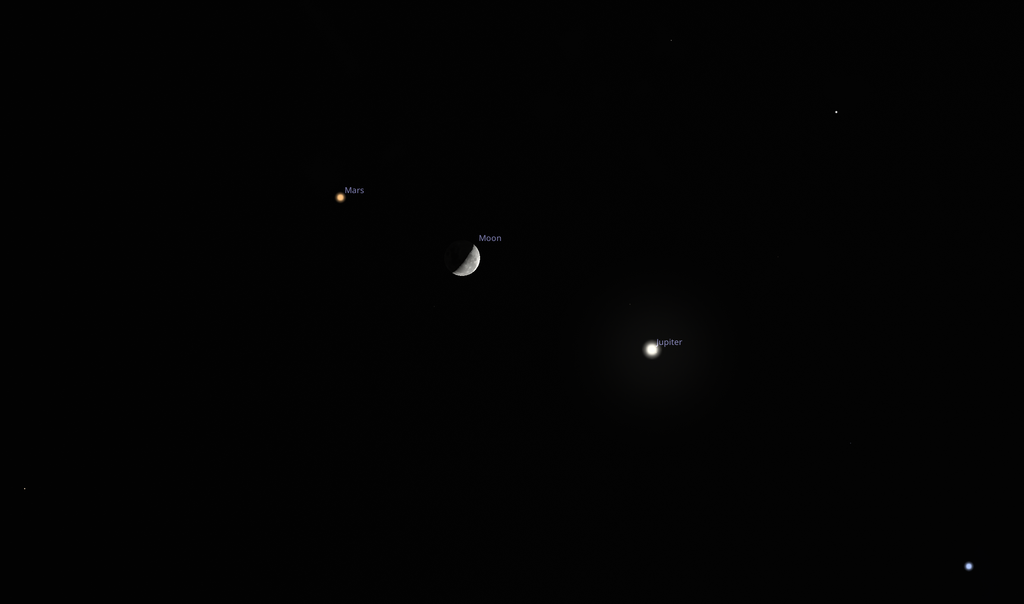
Look to the eastern sky from around 1:20 am AEST to spot the waning Moon forming a striking alignment with Mars and Jupiter. Jupiter will be the brightest object, while Mars adds its distinct orange-red glow nearby. This trio will be easy to spot with the naked eye, and binoculars will enhance the view.
7-8 November: Crescent Moon Meets Venus
A delicate waning crescent Moon appears close to brilliant Venus low in the eastern sky before sunrise. Look from around 4:00 am AEST to enjoy this attractive pairing during morning twilight. Venus will be unmistakable as the brightest object in the dawn sky, making this an easy naked-eye event.
9 November: New Moon
The Moon reaches its New Moon phase and is lost in the Sun’s glare. With no moonlight washing out the sky, this is the best time of the month to observe faint galaxies, nebulae and star clusters. Astrophotographers and deep-sky observers should make the most of the dark conditions.
15 November: Jupiter and Mars Conjunction
Jupiter and Mars make their closest approach of the month, appearing just over 1° apart in the early morning sky. Look towards the north-east from around 1:00 am AEST, where brilliant Jupiter and reddish Mars will sit side-by-side. The pair remain close for several mornings either side of the conjunction, making this one of November’s standout naked-eye planetary events.
20 November: Moon and Saturn Pairing
Saturn appears close to the waxing Moon throughout the evening, creating an attractive sight in the north-eastern sky. Visible from sunset until moonset, the pair can be enjoyed with the naked eye, while binoculars reveal the contrast between Saturn’s steady golden glow and the bright lunar surface.
20 November: Mercury at Greatest Western Elongation
Mercury reaches its greatest separation west of the Sun, offering one of the month’s best opportunities to spot the elusive planet. Look low above the eastern horizon shortly before sunrise. A clear horizon is essential, as Mercury remains relatively low in the bright morning twilight.
24 November: Full Moon
November’s Full Moon rises around sunset and remains visible all night. Bright moonlight will make faint deep-sky objects difficult to observe, but it provides an excellent opportunity for lunar observing and photography.
25 November: Uranus at Opposition
Uranus reaches opposition, placing it opposite the Sun in our sky and making it visible from sunset to sunrise. This marks the best time of the year to observe the distant ice giant, as it is at its brightest and closest to Earth for 2027. Under exceptionally dark skies it may be glimpsed with the naked eye, but binoculars or a small telescope are recommended to identify its subtle blue-green colour.
Lunar Phases
🌓 First Quarter Moon: 6 November 2027
🌕 Full Moon: 13 November 2027
🌗 Last Quarter Moon: 20 November 2027
🌑 New Moon: 27 November 2027
Learn more about the moon and lunar phases.
Lunar Occultations
2 November: Lunar Occultation of Mars
Mars will briefly disappear behind the Moon in a spectacular lunar occultation on 2-3 November at 12:15 UTC. Unfortunately, the occultation itself won’t be visible from Australia, with the best views reserved for observers in southern French Polynesia, the Cook Islands and Pitcairn. A small telescope or steady binoculars would reveal Mars slipping behind the lunar limb for those within the visibility path. While Brisbane observers will miss the occultation, a close conjunction between the Moon and Mars will be visible across a much wider region of the world, offering a beautiful pairing for astrophotographers and casual skywatchers alike.
3 November: Lunar Occultation of Jupiter
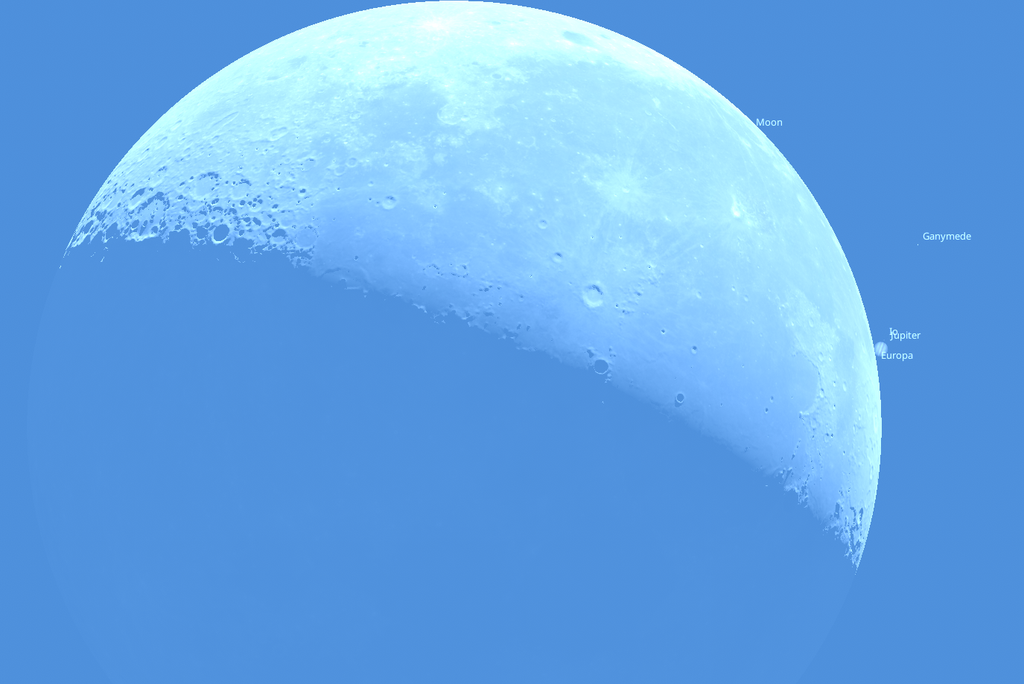
One of November’s standout events sees the Moon pass directly in front of Jupiter, creating a lunar occultation visible from Australia, Indonesia, Malaysia and parts of southern India. In Brisbane, Jupiter will disappear behind the Moon at approximately 10:00 AM AEST and reappear at 10:17 AM AEST, although both stages occur in daylight. A telescope is needed to observe this event, but extreme care must be taken to avoid accidentally pointing optics near the Sun. Even if the occultation is not visible from your location, the Moon and Jupiter will appear in a close conjunction that can be enjoyed by observers across a much broader area.
3 November: Lunar Occultation of Regulus
The Moon will pass in front of Regulus, the brightest star in Leo, at 6:59 UTC creating a lunar occultation visible across parts of South America including Brazil, Argentina, Peru and Bolivia. The event itself won’t be visible from Australia, but skywatchers can still enjoy a close conjunction between the Moon and Regulus. Binoculars will easily reveal the brilliant blue-white star nestled beside the Moon. This makes for a lovely observing target and a great photographic opportunity during the evening hours.
7 November: Lunar Occultation of Venus
From 9:26 UTC, the Moon will pass directly in front of dazzling Venus, creating a lunar occultation visible from Antarctica, Argentina, Chile and the Falkland Islands. Brisbane observers won’t see the occultation itself, but the close conjunction will still be worth seeking out. Venus is bright enough to be seen easily with the naked eye, while binoculars or a telescope will provide stunning views of the pair.
11 November: Lunar Occultation of Antares
The Moon will occult Antares, the fiery red heart of Scorpius, in an event occuring in the skies above Brisbane and parts of the South Pacific. Antares will disappear behind the Moon at approximately 3:33 PM AEST (2:24 UTC) and reappear at 4:06 PM AEST, though both stages occur during daylight hours. For those outside the occultation path, a close Moon-Antares conjunction will still be visible.
14 November: Lunar Occultation of Sigma Sagittarii (Nunki)
From 20:01 UTC, the Moon will pass in front of Sigma Sagittarii, also known as Nunki, one of the brightest stars in Sagittarius. The occultation will be visible mainly from parts of South America, including Brazil, Peru, Colombia and Venezuela. Unfortunately, Brisbane is outside the visibility path, but observers can still enjoy the close conjunction between Nunki and the Moon. Binoculars will help bring out the star against the bright lunar backdrop.
26 November: Lunar Occultation of Beta Tauri (Elnath)
The Moon will occult Elnath, the bright star marking one of Taurus’ horns at 22:15 UTC, in an event visible from parts of southern Africa. Australian observers won’t be able to see the occultation itself, but the Moon and Elnath will still appear close together in the sky. Binoculars are ideal for spotting Elnath near the lunar limb. This is a subtle but rewarding event for those who enjoy tracking the Moon’s journey through the zodiac constellations.
30 November: Lunar Occultation of Jupiter
From 7:15 UTC, the Moon once again passes in front of Jupiter, but this month’s second occultation favours observers in southern Chile, Argentina, Antarctica and the Falkland Islands. Brisbane observers will miss the occultation itself, though a close conjunction between the Moon and Jupiter will still be visible. Jupiter will shine brilliantly beside the lunar crescent, making this a gorgeous naked-eye sight. Binoculars or a telescope will reveal even more detail and create a stunning visual pairing.
30 November: Lunar Occultation of Regulus
The Moon will pass in front of Regulus in an occultation visible from Brisbane, New Zealand and Norfolk Island. In Brisbane, Regulus will disappear behind the Moon at approximately 11:34 PM AEST (1:11 UTC) before reappearing just a few minutes later at 11:37 PM AEST. Binoculars may be sufficient, but a small telescope will provide the best view of this delicate celestial hide-and-seek. If clouds interfere, don’t forget that the Moon and Regulus will still form a beautiful close conjunction visible across a much broader area.
Meteor Showers
4-5 November: Southern and Northern Taurid Meteor Shower Peak
The Taurids are a long-running meteor shower that typically produces around 5 to 10 meteors per hour. While numbers are modest, the shower is known for producing occasional bright fireballs. With only a thin waning crescent Moon in the sky, viewing conditions are favourable this year. Head somewhere dark after midnight and look generally towards Taurus, although meteors can appear anywhere across the sky.
18 November: Leonid Meteor Shower Peak
The Leonids peak overnight on 17-18 November, producing up to 15 meteors per hour under dark skies. Although moonlight may interfere earlier in the evening, the Moon sets after midnight, leaving darker conditions for observing. The best viewing window is from midnight until dawn, when Leo climbs higher into the sky.
Planetary Events
Mercury
Mercury remains a challenging target throughout November. The innermost planet passes through inferior conjunction early in the month before emerging into the morning sky, reaching greatest western elongation on 4 November. Despite this favourable geometry, Mercury rises less than an hour before the Sun and remains low in bright dawn twilight, making it difficult to spot from Australia.
Venus
Venus continues its return to the morning sky during November. It begins the month rising just over an hour before the Sun and by month’s end rises nearly two hours before sunrise, becoming an increasingly prominent Morning Star. Remaining within the constellation Virgo, Venus passes close to Spica during the first half of the month before forming a striking conjunction with Mars on 24 November. A lunar occultation of Venus occurs on 7 November, although it is only visible from parts of South America and Antarctica.
Mars
Mars spends November in Leo, shining at magnitude 0.7 in the pre-dawn sky. The Red Planet forms one of the month’s highlights on 16 November when it passes just over one degree from Jupiter, creating a noticeable contrast between Mars’ orange-red hue and Jupiter’s brilliant white glow. Mars then moves toward a close conjunction with Venus on 24 November. By the end of the month, Mars sits near Regulus and the waxing gibbous Moon, creating a noteworthy grouping before sunrise. A lunar occultation of Mars occurs on 2-3 November, but is not visible from Australia.
Jupiter
Jupiter remains the brightest planet in the morning sky throughout November, shining at magnitude -2.2. On 16 November, it forms a close conjunction with Mars, one of the month’s best naked-eye planetary events. The waning Moon passes close to Jupiter on 22 November, creating an attractive pairing in the early morning sky. A lunar occultation of Jupiter occurs on 3 November and is visible from Australia, with Brisbane observers able to watch Jupiter briefly disappear behind the Moon during daylight hours using suitable equipment. A second lunar occultation of Jupiter occurs on 30 November, but is not visible from Australia.
Saturn
Saturn continues to dominate the evening sky throughout November. Located in Cetus, it rises before sunset and remains visible for most of the night, setting around 3:00am by month’s end. The ringed planet is particularly well placed for telescopic observation during the evening hours. The waxing gibbous Moon passes close to Saturn around 11 November.
Uranus
Uranus reaches opposition on 30 November, making this the best time of the year to observe the distant ice giant. At opposition, Uranus rises at sunset, remains visible all night and reaches its maximum brightness for 2027.
Southern Hemisphere Comets
Evening Comets
- 161P/Hartley-IRAS (Mag 10)
- 10P/Tempel 2 (Mag 11)
- C/2024 T5 (ATLAS) (Mag 12)
Midnight Comets
- 10P/Tempel 2 (Magnitude 11)
- C/2024 T5 (ATLAS) (Magnitude 12)
Morning Comets
- 10P/Tempel 2 (Magnitude 11)
- C/2024 T5 (ATLAS) (Magnitude 12)
Northern Hemisphere Comets
Evening Comets
- 161P/Hartley-IRAS (Mag 10)
- 10P/Tempel 2 (Mag 11)
- C/2026 A2 (Bok) (Mag 12)
Midnight Comets
- 10P/Tempel 2 (Mag 11)
- C/2024 T5 (ATLAS) (Mag 12)
- 11P/Tempel-Swift-LINEAR (Mag 12)
Morning Comets
- 252P/LINEAR (Mag 11)
- C/2024 T5 (ATLAS) (Mag 12)
- 11P/Tempel-Swift-LINEAR (Mag 12)
Show Your Support
If you enjoy guides like this and want to help me keep creating them, you can show your support by donating. Every contribution genuinely helps me spend more time under the night sky and bring these resources to life. You can also follow me on Instagram and Facebook, where I post reminders closer to each event so you never miss a moment happening overhead.
Leave a Reply