Some nebulae are attention seekers. Orion practically struts across the sky like it owns the place. Others, like Sh2-34, are more subtle. They whisper rather than shout. But give them enough time, the right filters, and a little patience, and they reward you with something pretty special.
Discovered as part of the Sharpless Catalogue of HII regions back in the 1950s, Sh2-34 doesn’t exactly leap out at you. Visually, it’s so faint that you’d never know it was there. But throw narrowband filters into the mix and suddenly wisps and clouds of gas start spilling across the frame like cosmic smoke.
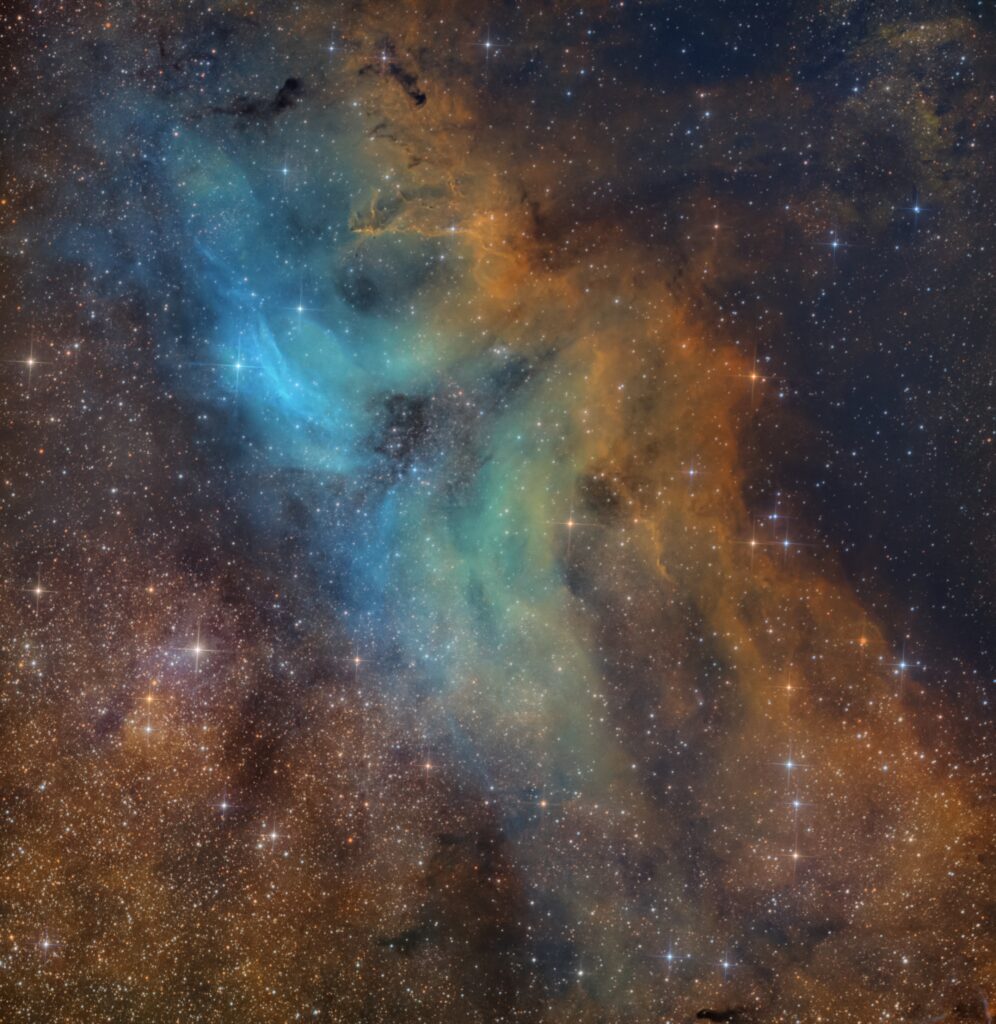
What you’re seeing
- The blue-green regions are oxygen (OIII), glowing from highly energetic gas.
- The golden hues come from sulphur (SII) and hydrogen-alpha (Ha), illuminated by nearby hot young stars.
Together they form a sprawling stellar nursery around 1,300 light-years away. Gravity is slowly pulling gas and dust together, eventually giving birth to new stars.
The photons that landed on my camera this week left Sh2-34 around the time humans were just figuring out that drawing bison on cave walls was apparently peak interior decorating.
Photographing Sh2-34
This target is sneaky. It doesn’t punch through light pollution easily, and the faint outer structures demand patience. Lots of patience. The sort of patience usually reserved for waiting for your neighbour to turn off their backyard floodlight.
I spent several nights collecting enough data using Antlia 3nm SHO filters. I also donated a respectable amount of blood to the local mozzie population and became intimately familiar with every dog turd in the backyard while stumbling around in the dark. Occupational hazards, apparently.
Processed in the Hubble Palette, the colours reveal structures that our eyes could never see directly. It’s always a little surreal watching these faint wisps emerge from what initially looks like a frame full of stars and noise.
That’s one of the things I love about astrophotography. There are treasures hidden everywhere in the sky. Sometimes you just have to spend hours under the stars, lose feeling in your backside, and swear at your guiding graph to uncover them.
And honestly? I reckon Sh2-34 was worth every mozzie bite.
Why I love it
Sh2-34 isn’t famous. You won’t see it on T-shirts or tattoos like Orion or the Eagle Nebula. But that’s why I adore it — it’s like catching a secret whispered by the universe, something only a patient astrophotographer gets to reveal.
So here it is: my take on a subtle, sprawling jewel in the Sharpless catalogue. Proof that even the quiet corners of the Milky Way have stories to tell — if you’re willing to listen.